Want to read with me? Follow this link to view the list and pick a book (or a few!) to read along with me. I'd love for this project to be collaborative, and will post anyone's thoughts beside my own.

Wednesday, January 14, 2015

What is the certainty of caprice?

Emma by Jane Austen

Spoiler Alert: Plot Summary
Emma is a tale of mistaken matchmaking and the love that surprises you by appearing mysteriously where only friendship existed before. It chronicles a few months in the life of Miss Emma Woodhouse, the (unmarried) younger of Mr. Woodhouse's two daughters, and her (mostly ill-fated and often mischief-causing) attempts at matchmaking. Emma makes a project out of a local girl, Harriet, whose parentage is unknown, and whose prospects are minimal at best. Emma tries to set her up with first Mr. Elton, an eligible bacheldore, and then Frank Churchill, who it turns out (DUN DUN DUN) is not as eligible as he seems (#secretengagement #JaneFairfaxcankeepasecret #secretssecretsarenofunsecretsarentforeveryone #iknowwhogaveyouthatpianoforte) If this is starting to sound familiar, it might be because you're a member of civilized society and you've seen the movie Clueless once or twice before. ;) Several men set their sights on Emma, and one, the semi-avuncular but eminently lovable Mr. Knightley (Mr. George Knightley, not to be confused with his brother, Mr. John Knightley, who is married to Emma's sister - I know, Really Really Tangled!) is successful. Harriet finds her way back to her initial love interest, a Mr. Robert Martin, who is very kind and sweet and after all not so very poor, and everybody lives Happily Ever After.
Spoiler Over: Continue Here

I'm fairly sure I read this book at least once before, and I've definitely seen both Clueless and the Gwyneth Paltrow version of Emma, so nothing was really a surprise. That said, Emma (the book and the titular character) really grew on me. I think P and P will always be my favorite Austen, but Emma has perhaps the greatest growth of all Austen's heroines (at least of P and P, S and S, and Persuasion, which I've read) and in a way, that makes her all the more worthy of affection and a happy ending. 

Forgive me if this blog runs long, as I've spent most of the day wanting to be exactly where I am now (#snuggled #withinpettingreachofmycat #warm #itwasfourdegreesthismorning) and am happily enjoying the experience of writing this entry. 

- Least lovable, and therefore most worth loving
As I mentioned earlier, Emma has many faults. She is vain, she fancies herself a gifted matchmaker, and she sees it as her right and duty to meddle in the business of others. Over the course of the novel, though, she learns (in an understated, not an overhanded sort of way) to modify her behavior, and grows into a truly lovely specimen of a woman and a human being. If Emma were an Austen character cocktail, she would be a drink that starts with the bitter haughtiness of Caroline Bingley/Mr. Darcy circa early P and P and finishes with the delicate sweetness of penitent, learned Elinor Dashwood and a citrus splash of Marianne Dashwood's adventurous tartness mixed in. 

- Tidy bow, but not unrealistically so
I must admit I appreciate that Austen's books end happily. I haven't read all of them, but the ones I have read (S and S, P and P, Persuasion, and Emma) have a way of tidily tying up loose ends, but without seeming to stretch the fabric of reality too intensely in doing so. There's a sense of things all coming out right in the end that I find deeply satisfying. Some people like a complex ending, but then again some people like a good unresolved chord at the end of a jazz riff, and I've never been much for either. I'll take happiness and harmony any day; we certainly have a shortage of happy stories in this world (and seem to derive a perverse pleasure in telling the sad ones), so I say let's take the happy where we can.

- Modern version of an 19th century woman
Whenever I read Austen, I am reminded of what an Excellent 19th century woman I would make. I love reading, and embroidery, and cards, and playing musical instruments, and singing, and lively conversation. What more could a girl ask for? #borninthewrongcentury #icanstillbeafeministandlikethosethings ;) #areyoulovingtheironicalhashtagsinthispost?

- Mr. Woodhouse = Puddleglum = Marvin the Robot
Emma's father, Mr. Woodhouse, was easily my favorite character. He reminded me a great deal of Puddleglum, the depressed Marsh-Wiggle of Narnian fame, and Marvin, the manically depressed robot from Hitchhiker's Guide to the Galaxy. Here are some comparison quotes for your enjoyment:

Mr. Woodhouse, on Emma's painting of Harriet: "It is very pretty. Just as your drawings always are, my dear. The only thing I do not thoroughly like is, that she seem to be sitting out of doors, with only a little shawl over her shoulders - and it makes one think she must catch cold."
  'But, my dear papa, it is supposed to be summer; a warm day in summer. Look at the tree.'
 'But it is never safe to sit out of doors, my dear."

Puddleglum, when the children first meet him and he tells them they can try to light a fire: "You could light it inside the wigwam, and then we'd all get the smoke in our eyes. Or you could light it inside, and then the rain would come and put it out. Here's my tinder box. You wouldn't know how to use it I expect?"

Mr. Woodhouse on venturing out to be with company in wintertime:
"Going in dismal weather, to return probably in worse; - four horses and four servants taken out for nothing but to convey five idle, shivering creatures into colder rooms and worse company than they might have had at home. The folly of not allowing people to be comfortable at home - and the folly of people's not staying comfortably at home when they can!" I couldn't agree more! How Comfortable I am here snuggled in my warm apartment with my cat!

When Eustace comments on the weather, Puddleglum's reply:
"Very likely, what with enemies, and mountains, and rivers to cross, and losing our way, and next to nothing to eat, and sore feet, we'll hardly notice the weather. And if we don't get far enough to do any good, we may get far enough not to get back in a hurry." That's the Spirit, Puddleglum! ;)

Mr Woodhouse, on the plan to move a potential ball from Randalls, their friends' home, to the Crown Inn: "No, he thought it very far from an improvement - a very bad plan - much worse than the other. A room at an inn was always damp and dangerous; never properly aired, or fit to be inhabited. If they must dance, they had better dance at Randalls. He had never been in the room at the Crown in his life - did not know the people who kept it by sight. Oh! no - a very bad plan. They would catch worse colds at the Crown than anywhere."

Marvin's exchange with Ford Prefect:
Ford: "How are you, metalman?"
Marvin: "Very depressed."
Ford: "What's up?"
Marvin: "I don't know. I've never been there." haghaghahgahghaghaghagh

On Emma's plan to go to a shindig at a neighbor's house:
"You will get very tired when tea is over.'
 'But you would not wish me to come away before I am tired, papa?'
'Oh! no, my love; but you will soon be tired. There will be a great many people talking at once. You will not like the noise.'
'But, my dear sir,' cried Mr. Weston, 'if Emma comes away early, it will be breaking up the party.'
' And no great harm if it does,' said Mr. Woodhouse. 'The sooner every party breaks up, the better." heh heh heh heh

Mr. Woodhouse on young ladies, aka delicate plants:
"I am very sorry to hear, Miss Fairfax, of your being out this morning in the rain. Young ladies should take care of themselves. -Young ladies are delicate plants. They should take care of their health and their complexion." hear that, young ladies? we are Delicate Plants. What delicate plant are you? I fancy I'm a cyclamen. Or perhaps a hyacinth. 

And my favorite, Mr. Woodhouse's insistence on the Windex cure to life: Gruel.
"You must go to bed early, my dear Isabella - and I recommend a little gruel to you before you go. - You and I will have a nice basin of gruel together. My dear Emma, suppose we all have a little gruel." yes, suppose we all have a little gruel! gruel, anyone? 

- Look, let's just tawk when we've mellowed.
I suppose this is the feedback loop Jasper Fforde mentioned in One of Our Thursdays is Missing, but I greatly enjoyed imagining Ty in Harriet. Here are a few nuggets:
  • "Harriet was one of those, who, having once begun, would be always in love."
  • When Harriet brings over keepsakes from Mr. Elton to BURN after she finds her affection unrequited: "She held the parcel towards her, and Emma read the words Most precious treasures on the top. Her curiosity was greatly excited." The parcel contained a bit of old bandage and the end of a pencil that Mr. Elton had once used to write a memorandum with. I believe in Clueless there's a kitchen towel he used to mop her brow with after her Rollin' with the Homies incident. ;) haghahgahgagh Most Precious Treasures. #rotfl #wastheoneringintheretobindthem?
- Classic Austenisms
What is an Austen novel without a foppish man?
  • "Emma's very good opinion of Frank Churchill was a little shaken the following day, by hearing that he was gone off to London, merely to have his hair cut. A sudden freak seemed to have seized him at breakfast, and he had sent for a chaise and set off, intending to return to dinner, but with no more important view that appeared than having his hair cut."
Or a musical heroine who is capable, but not a True Proficient?
  • "Emma did unfeignedly and unequivocally regret the inferiority of her own playing and singing. She did most heartily grieve over the idleness of her childhood - and sat down and practised vigorously an hour and a half."
  • Emma, after a compliment from Harriet:"Don't class us together, Harriet. My playing is no more like hers, than a lamp is like sunshine."
Or a quarrel between friends/lovers?
  • "She hoped they might now become friends again. She thought it was time to make up. She certainly had not been in the wrong, and he would never own that he had." oh, OK. great. glad we cleared that one up. so Nobody's to blame!
Or a high quality, character-building, teachable moment?
  • "Never had she felt so agitated, mortified, grieved, at any circumstance in her life. She was most forcibly struck. The truth of this representation there was no denying. She felt it at her heart. How could she have been so brutal, so cruel, to Miss Bates! How could she have exposed herself to such ill opinion in any one she valued!"
  • -"A whole evening of back-gammon with her father was felicity to it."
  • "As a daughter, she hoped she was not without a heart." that's right, Emma, you backgammon your cares away! #gamenightwillsetyouright
Or a seriously misguided proposal?
  • Mr. Elton: "Miss Smith, indeed! -Oh! Miss Woodhouse! Who can think of Miss Smith, when Miss Woodhouse is near!"
  • Emma, deeply displeased: "It would be impossible to say what Emma felt, on hearing this - which of all her unpleasant sensations was uppermost." haghaghaghahgahg #allthefeels
  • And, the final blow from Emma: "I have no thoughts of matrimony at present." Burn!
I must admit to being quite delighted that this book differs from some other Austen novels, however, in that we get a solid forty pages after the heroine has secured her epic love. So nice to get to marinate in their joy! How I long for forty pages of happy Darcy and Elizabeth! We get one happy scene at Pemberley, and that is all we are to be satisfied with!

Words that maybe still exist (I don't know - you tell me! It's a quiz!):

valetudinarian - a person who is unduly anxious about their health (OH OK. so me! ;)

chilblain - a painful, itching swelling on the skin, typically on a hand or foot, caused by poor circulation in the skin when exposed to cold (oh, OK. so life in New Hampshire! again, like me!)

coxcomb - a vain and conceited main; a dandy (ooh ooh, I know! like Wickham!)

impute - represent (something, esp. something undesirable) as being done, caused, or possessed by someone; attribute (NO NO no no No No NO! imputing is a technique you use in data cleaning, and it is HEAVILY frowned upon by some members of the policy community. Dictionary got that one Wrong! [pats self on back]

Particularly pleasing passages:
  • On Mr. Elton and Emma after he proposes to her, unsuccessfully: "If there had not been so much anger, there would have been desperate awkwardness; but their straightforward emotions left no room for the little zigzags of embarrassment." no room for zigzags of embarassment! none at all!
  • "The youth and cheerfulness of morning are in happy analogy."
  • "I cannot make speeches, Emma! If I loved you less, I might be able to talk about it more."
One of my favorite twists is that even though dear Mr. Knightley (George, not John) is kind and good enough to offer to move in with Emma and her father at Hartfield and quit his own property at Donwell, Mr. Woodhouse is too delicate to handle the prospect of their marriage. They try to persuade him: "Did he not love Mr. Knightley very much? Would not he like to have him always on the spot?"
"Yes. That was all very true. Mr. Knightley could not be there too often; he should be glad to see him every day; -but they did see him every day as it was. -Why could not they go on as they had done?" and in the end, the only reason he is happy to consent is... PILfered POUltry! Someone has been getting into the henhouses (Litrally) near the Woodhouses, and Mr. Woodhouse is so put out that he MUST have Mr. Knightley always nearby to protect them.  ahghaghagh #thanksforthechickensstupid

I'll leave you with some bits about Emma that resonated with me:
Emma's response to Harriet, on Emma being an old maid: "A single woman, with a very narrow income, must be a ridiculous, disagreeable old maid! the proper sport of boys and girls, but a single woman, of good fortune, is always respectable, and may be as sensible and pleasant as anybody else."
- 'But you will be an old maid! and that's so dreadful!
  'I shall not be a poor old maid; and it is poverty only which makes celibacy contemptible to a generous public!" you tell her, Emma! I mean, I'm okay with solitude AND poverty, but as a semi-wealthy single lady, I am glad to hear Emma supports me ;)

Emma's governess: "Emma has been meaning to read more ever since she was twelve years old. I have seen a great many lists of her drawing-up at various times of books that she meant to read regularly through - and very good lists they were - very well chosen, and very neatly arranged - sometimes alphabetically, and sometimes by some other rule. The list she drew up when only fourteen - I remember thinking it did her judgment so much credit, that I preserved it some time; and I dare say she may have made out a very good list now." Oh don't WORRY, Emma. I've got a GOOD list for us to tackle. But we're nearing the end! Can we swapsies?

at one point, Knightley describes his future wife, and points out quite specifically that she must have "the hazle eye, the True hazle eye." guess what, Knightley? hazel eyes right here! on my driver's license and everything! come on DOWN!

When Emma finally realizes she loves Knightley and he loves her and all will be right with the world:
"She was in dancing, singing, exclaiming spirits; and till she had moved about, and talked to herself, and laughed and reflected, she could be fit for nothing rational. She was really in danger of becoming too happy for security."

I hope you all may soon find yourselves in very real danger of becoming too happy for security. I wish you warmth, a cat to snuggle with, and a really good book. I'm on to Cherished. NO, that's not right. Adored? Adorned? Wait, that's a Miguel song. Well you know what I mean! Join me if you chuse! (see what I did there with the British spelling? #adorable #toomanyhashtags #nosuchthing)

Saturday, December 6, 2014

She was one of those children possessed by a desire to have the world just so.

Atonement by Ian McEwan

Spoiler Alert: Plot Summary
Atonement is a story about love, lust, coming of age, and the danger that follows an imagination run wild. The plot's fulcrum is a dinner party held in 1930's England by the aristocratic Tallis family to welcome home their eldest, Leon. We view the events through the eyes of Briony Tallis, the precocious 13-year-old youngest child and wannabe writer. Just before the dinner party starts, Briony accidentallyonpurpose interrupts her older sister Cecilia having a moment (that may or may not be sexual in nature) with Robbie Turner, the son of the family's housekeeper and a longtime friend of the family. Due to a previous mishap, Briony has read a rather personal (and accidentally over-graphic [long story, think two versions of a letter and one not meant for public eyes]) letter that Robbie wrote to Cecilia. With these events set in motion, Briony becomes convinced that Robbie is to blame hours later when a rape occurs on the grounds and her cousin Lola is the victim. Lola was caught unawares and, with the darkness and heightened emotions, is moderately uncertain of (and uncomfortable revealing) the culprit, but Briony's confidence in Robbie's guilt is enough to persuade Lola and send Robbie to prison. The story picks up during World War II. Cecilia is a nurse, Briony has started training to become a nurse (to everybody's surprise), Robbie has been released from prison to fight in the war, Robbie and Cecilia remain passionately in love despite being physically distant, and Cecilia has alienated herself from her entire family, remaining staunchly convinced of Robbie's innocence. There's a stupid and obnoxious twist where you think for a moment that all ends well - Briony plans to confess and atone for her error, Robbie has returned home safely from war, and there's a possibility of forgiveness somewhere far down the line between Cecilia and Briony. BUT THEN NO. JK. It was a miserable lousy lie, and in fact Robbie is dead (sepsis, war) Cecilia is dead (bombing, flood) and Briony is having a stupid birthday party in her 80's with her family, never having published her story of this crazy epic life of hers because the real rapist, Paul Marshall (who was a friend visiting with Leon and was never suspected by anyone except Lola) ended up marrying Lola (I know, TWISTED) and they are very powerful and married so the point is mostly moot except for having ruined Robbie and Cecilia's lives. THE. End. 
Spoiler Over: Continue Here

I think I was supposed to love this book. I mean, it received pretty widespread acclaim, and the movie was Oscar nominated, etc. etc. BLAH BLAH BLAH ME ME ME MY MY MY NOW NOW NOW. 

I did not love this book. This was the second time I read it, and I felt exactly the same about it both times. Here's my assessment:
  • First section (dinner party, up to Robbie's arrest): Exquisite. Some of the best writing I've ever read. 
  • War section (Robbie at War, Cecilia as a nurse, fake twist): Tripe. Complete and utter tripe. Writing nowhere near the level of the first section, and it was Painfully Apparent to me that Ian McEwan had not been in World War II, and was writing about an era with which he was completely unfamiliar (not having been ALIVE until 1948, let alone having been anywhere near the war).
  • Final section (Briony's present day, bday party, etc): Total let down. Not just disappointing in the super depressing ending, but in my opinion, made very little sense with the rest of the book, and felt contrived and completely separate from the other two portions of the novel. 
Granted, this is just my opinion. Many people I know love Ian McEwan's work, and that's cool. I haven't read any of his other works, but if anything is like the first section of Atonement, I'm all over it. Otherwise, Count. Me. Out.

I'd like to paint a picture of the characters for you, as it's really a prolonged character study (well, the really great first section is, anyway). Here is the cast of characters, in no particular order:

Briony Tallis - 13 years old at the book's outset, younger sister of Cecilia and Leon Tallis
  • "Briony's was the only tidy upstairs room in the house. Her straight-backed dolls in their many-roomed mansion appeared to be under strict instructions not to touch the walls." I love this image - it makes me think of Toy Story and the toys being told not to step out of line, whether or not Andy was around. ;)
  • "As she saw the dress make its perfect, clinging fit around her cousin and witnessed her mother's heartless smile, Briony knew her only reasonable choice then would be to run away, to live under hedges, eat berries and speak to no one, and be found by a bearded woodsman one winter's dawn, curled up at the base of a giant oak, beautiful and dead, and barefoot, or perhaps wearing the ballet pumps with the pink ribbon straps..." Ah yes, obviously the only Reasonable choice. If Reasonable is defined as INSANELY DRAMATIC. 
  • "It was wrong to open people's letters, but it was right, it was essential, for her to know everything." And they'll ask me, the hardened criminals in prison, what are you here for? Murder? Drugs? And I'll say, Opening. Ben's. Letter. 
Lola Quincey, 15-year-old cousin to Briony, brought into the world of the Tallis household due to her parents' recent divorce
  • "Lola was perfectly composed, having liberally applied perfume and changed into a green gingham frock to offset her coloring. Her sandals revealed an ankle bracelet and toenails painted vermilion. The sight of these nails gave Briony a constricting sensation around her sternum, and she knew at once that she could not ask Lola to play the prince." Briony penned a play for the cousins to put on to astound her family and Leon with her magnificent brilliance. She had hoped to ask Lola to play the prince. But alas, Lola was hardly prince material. This reminded me of when my sisters and I used to act out plays with our cousins like "The Importance of Being Earnest" in our basement with dress up clothes. We always had to vote on who would play the male parts because we had a plethora of young ladies and rarely any boys (cousins or neighbors) interested in participating in our charade. (I know, IMAGINE adolescent boys not wanting to play gallant gentlemen in Oscar Wilde plays!)
  • To the twins, her younger brothers: "You'll be in this play or I'll speak to The Parents." I love the use of the The Parents here - it reminded me of how Dickens refers to the Aged P. Give him a nod, will you? You've no idea how much it pleases him, Pip!
The twins, Lola's younger brothers Jackson and Pierrot, also sent to the Tallis household due to their parents' D-I-V-O-R-C-E
  • "The vulnerable Quinceys were being coerced.  Lola: "'Remember what The Parents said? We're guests in this house and we make ourselves - what do we make ourselves? Come on. What do we make ourselves?'  'A-menable,' the twins chorused in misery, barely stumbling over the unusual word."
  • "There had been trouble enough already, but Briony began to understand the chasm that lay between an idea and its execution only when Jackson began to read from his sheet in a stricken monotone, as though each word was a name on a list of dead people, and was unable to pronounce 'inexperienced' even though it was said for him many times." ahghaghahgahgagh. I love the description of the twins butchering their lines in Briony's play, and her horror at their inability to live up to her expectations.
  • Paul: "'What marvelous names you all have. But how am I supposed to tell you two apart?'   Pierrot: "I'm generally considered more pleasant." ahghaghaghaghghaghg. 
  • Note left for the household: 
            We are gong to run away becase Lola and Betty are horid to us and we want to go home. 
             Sory we took some frute And there was'nt a play." aghagahgagha. I love this so much. 
  • On Paul's assertion that Amo chocolate bars would sweep the nation: "The twins looked at each other. They knew that an adult had no business with sweets. Pierrot said, 'Soldiers don't eat chocolate.'" I want chocolate. Not white chocolate, Real TCHocolate. 
Cecilia Tallis, Briony's older sister, Robbie's lover
  • "She could not remain here, she knew she should make plans, but she did nothing. There were various possibilities, all equally unpressing."
  • "In fact, the thought of packing a suitcase and taking the morning train did not excite her."
  • On Paul: "Watching him during the first several minutes of his delivery, Cecilia felt a pleasant sinking sensation in her stomach as she contemplated how deliciously self-destructive it would be, almost erotic, to be married to a man so nearly handsome, so hugely rich, so unfathomably stupid. He would fill her with his big-faced children, all of them loud, boneheaded boys with a passion for guns and football and aeroplanes." I love the line "fill her with his big-faced children". Find a wench, raise fat babies, and live a good long life. 
Leon Tallis, the oldest sibling and Briony's idol
  • "When they embraced, Cecilia felt against her collarbone through the fabric of his jacket a thick fountain pen, and smelled pipe smoke in the folds of his clothes." Leon plays a small role in the book, but I love this quick snapshot that we get of him via Briony. 
Emily Tallis, the matriarch of the household, and the only adult on the scene when her husband remained in the city "at work"
  • On her migraines: "She felt in the top right corner of her brain a heaviness, the inert body weight of some curled and sleeping animal; but when she touched her head and pressed, the presence disappeared from the coordinates of actual space. Now it was in the top right corner of her mind, and in her imagination she could stand on tiptoe and raise her right hand to it. It was important, however, not to provoke it; once this lazy creature moved from the peripheries to the center, then the knifing pains would obliterate all thought, and there would be no chance of dining with Leon and the family tonight." 
  • "Habitual fretting about her children, her husband, her sister, the help, had rubbed her senses raw; migraine, mother love and, over the years, many hours of lying still on her bed, had distilled from this sensitivity a sixth sense, a tentacular awareness that reached out from the dimness and moved through the house, unseen and all-knowing ... She lay in the dark and knew everything." McEwan's description of Emily's condition is immaculate. 
Robbie Turner, son of the housekeeper, Cecilia's lover, supported financially by the Tallises until the supposed crime and ensuing arrest 
  • "It was an interesting combination in a man, intelligence and sheer bulk." It is surprising how infrequently the two go together, is it not? Is there a scientific reason for this that I'm missing?
  • "He had found out for himself what it was to be in love, and it thrilled him."
  • "There was a story he was plotting with himself as the hero, and already its opening had caused a little shock among his friends."
  • "He had never before felt so self-consciously young, nor experienced such appetite, such impatience for the story to begin."
  • On literature: "It was not the necessary priesthood, nor the most vital pursuit of an inquiring mind, nor the first and last defense against a barbarian horde, any more than the study of painting or music, history or science."
  • "He would be a better doctor for having read literature. What deep readings his modified sensibility might make of human suffering, of the self-destructive folly or sheer bad luck that drive men toward ill health! Birth, death, and frailty in between...Broad tolerance and the long view, an inconspicuously warm heart and cool judgment; his kind of doctor would be alive to the monstrous patterns of fate, and to the vain and comic denial of the inevitable; he would press the enfeebled pulse, hear the expiring breath, feel the fevered hand begin to cool and reflect, in the manner that only literature and religion teach, on the puniness and nobility of mankind..." We are all better people for having read literature. I believe this beyond the shadow of a doubt, and look - research says so, too! For a beautiful response to an Op-Ed challenging this research, read this article on why deep reading makes us smarter and nicer. 
Here's one of my favorite lines from the article: 
"The deep reader, protected from distractions and attuned to the nuances of language, enters a state that psychologist Victor Nell, in a study of the psychology of pleasure reading, likens to a hypnotic trance. Nell found that when readers are enjoying the experience the most, the pace of their reading actually slows. The combination of fast, fluent decoding of words and slow, unhurried progress on the page gives deep readers time to enrich their reading with reflection, analysis, and their own memories and opinions. It gives them time to establish an intimate relationship with the author, the two of them engaged in an extended and ardent conversation like people falling in love."
  • "He was in love, with Cecilia, with the twins, with success and the dawn and its curious glowing mist."
Now that I've painted you a quick portrait of the characters, here are a few final thoughts: 

On England, the war, and Narnia

The twins and Lola (the Quinceys) are deposited in the Tallis household without a thought, and Briony accepts this, remembering "She had heard it said that the house could easily absorb three children." I loved the image of the house absorbing children, just gobbling them right up, and it immediately reminded me of the first Narnia book when the Pevensies are deposited in the Professor's spacious home and no one is there to pay them much mind.

On the War
Having read 90 of the books on this list, as well as quite a few others, I've come to agree deeply with a sentiment that many writers have expressed, but most memorably (for me) Ernest Hemingway and Louisa May Alcott drilled home: Write what you know. Or, in my opinion, conversely, don't write what you don't know. This isn't strictly literal for me, in that fantasy authors clearly write about a world of their own creation. And yet, there's a sense of deep rooted normalcy and intimate personal connection in some of the best fantasy - the habits and day to day lives of their characters, the physical and sometimes temporal location, and the relationships are all grounded in ideas and concepts that are not unknown to the author. Even dystopias can be extrapolations of the known world, or expanded and exaggerated conceptions of existing fears and trends. My major issue with the middle of this book is that Ian McEwan cannot possibly Know World War II, and while there are relationships and themes that travel through from the first segment of the book, the majority of the second section is centered on the daily life of soldiers and nurses in World War II England and France. At one point, McEwan even has Robbie ponder to himself, "No one would ever know what it was like to be here." Yes, McEwan - see? You got THAT right. No one will know what it was like, Except for people who WERE THERE. So don't try to write what you don't know. I find it offensive, even if you're trying to do present day readers a solid by capturing history. I wrestled with this a little, because some great writers captured pivotal moments in history. But I guess I would make the argument that even if Dickens wrote A Tale of Two Cities and it's beautiful and epic, it's David Copperfield and Great Expectations where, in my opinion, his true brilliance shines, and that's because it acutely speaks to his own experience, as does Proust's Remembrance of Things Past, as does Louisa May Alcott's Little Women, as does Virginia Woolf's To the Lighthouse, as does Jane Austen's body of work, and Harper Lee's To Kill a Mockingbird and Vonnegut's Slaughterhouse-Five. I think the best authors, the real all-time greats, figure out how to tell their stories through the lens of their own experience, and it is this honesty and this reflection of their perception of the world that makes a classic novel so spectacularly resonant. I'm curious to hear your thoughts, though, readers. Do you agree? Can you think of brilliant authors who don't write just what they know

And now for a lovely section --Wonderfully Inventive Words I Wasn't Previously Aware Of;


whorl - a coil or ring, or a complete circle on a fingerprint

ha-ha - a ditch with a wall on its inner side below ground level, forming a boundary to a park or garden without interrupting the view (did you know this is a thing? I was marvelously amused by this.)

supine - lying face upward (I think I knew prone was the converse, but supine was new to me!) (from the Latin, of course, Mommy!)

oasthouse - (also, hop kiln) a building designed for drying hops as part of the brewing process (Look at these - they are also super fun! Like hobbit holes, almost! And what a fun word to say! Oasthouse. Oasthouse. See? A delight!)


pergola - an archway in a garden or park consisting of a framework covered with trained climbing or trailing plants (so pretty! I want one! And an oasthouse, too, please! KTHANXBYE)

fug - a warm stuffy or smoky atmosphere in a room (I would like to say fuggy - like, the bars in Tolkien novels are so delightfully fuggy - can I say that?)

topers - those who drink alcohol to excess, especially on a regular basis

anodyne - not likely to provoke dissent or offense; uncontentious or inoffensive, often deliberately so


harebells - widely distributed bellflowers with slender stems and pale blue flowers in late summer


Passages that pleased me:
  • Briony's imagination: "There were moments in the summer dusk after her light was out, when she burrowed in the delicious gloom of her canopy bed, and made her heart thud with luminous, yearning fantasies, little playlets in themselves."
  • "A woman in a paisley apron was sweeping with demented vigor in front of her house through whose open door came the smell of fried breakfast." Such a fantastic sentence.
  • On the French windows in the sitting room: "Their southeast aspect had permitted parallelograms of morning sunlight to advance across the powder-blue carpet." This reminds me of the line from Jane Eyre - "Daylight began to forsake the red-room."
  • "The truth had become as ghostly as invention."
Well, I hope you enjoyed reading this post more than I enjoyed reading the second half of Atonement (which honestly isn't saying much! ;). It is icy and cold here in New Hampshire, and the holidays are a brewing! I'm looking forward to visitors from the Deep Dirty South and mugs of hot cocoa and ooey gooey Christmas sticky buns. 

I'm on to the final ten with Emma! Join me if you care and want to share! Enjoy your December, wherever you are!

Friday, October 24, 2014

Kissing is forbidden between us. This makes it bearable.

The Handmaid's Tale by Margaret Atwood

Spoiler Alert: Plot Summary

The Handmaid's Tale is set in a hyper-Christian dystopian society where nuclear spills and rampant pollution have left only a tiny portion of the female populace capable of reproducing. (I KNOW, right? GREAT START.) The superlucky women able to reproduce are required to serve as 'handmaidens' to the upper echelon of women who are unable to reproduce. The government's justification for this policy is the biblical precedent of Abraham and Jacob taking handmaids to bed when their wives were unable to bear children (hey - if the Bible says it's OK, it's OBviously OK.). When the book opens, the narrator, Offred, is currently a handmaid to a man known simply as 'the Commander' and his wife, Serena Joy. This is Offred's third handmaiden placement (3rd time's the charm!). Offred is allowed to live with the family and provided room and board with the expectation that once a month she participate in a ceremony in which she, the Commander, and Serena Joy spend some Quality Time together. (I think you get my drift. And oh yeah, that's right - Serena Joy is there, too. And not in a fun sort of way.) If Offred becomes pregnant, she will be hailed as a hero and the baby will be given to Serena Joy to raise. If Offred attempts to escape, she will be killed or sent to 'the Colonies' to clean up toxic waste, which is essentially a death sentence. (Great choices, right? GET PREGNANT OR DIE. But no pressure.)  The novel chronicles Offred's time with the Commander and Serena Joy while simultaneously flashing back to Offred's life before the handmaid era. Offred had a husband, Luke, and a daughter, but she lost touch with them in their attempted escape to the Canada, and she doesn't know if they are alive or dead. Over time, Offred develops a bizarre relationship with the Commander, who seeks companionship (and I mean actual companionship, not code for anything sexual - see Scrabble below) from warmer company than his (demonic shrew of a) wife can provide. Offred's small acts of rebellion with the Commander make her more and more confident and lead her to further test boundaries (and violate the law) by engaging in relations (OK, yes, this time I do mean sexual) with Nick, the house's driver. Offred also becomes aware of a counter-revolution movement through another handmaid, Ofglen, but when Ofglen disappears (code for commits suicide), Offred is left with newfound confidence and no connections to the resistance. The book ends with Offred being taken away in a van by 'the Eyes', the government's equivalent of the secret police, and we are unsure whether they are true 'Eyes' or members of the resistance in disguise.
Spoiler Over: Continue Here

For the most part, I enjoyed reading this book. I thought I had read it once before, in my AP Language and Composition class senior year, but now I think perhaps we only read excerpts, as several sections seemed totally new to me. [Fun nerd fact: I petitioned the school to let me take both AP Language and AP Literature my senior year because it was the first year they offered AP Language (AND BECAUSE I'M AWESOME LIKE THAT). I gave up a lunch period and ate in French class with my besty, Dee. Best decision ever! I got to read SO MANY THINGS! All of the books! haghahgahghag #suchanerd #sorrynotsorry] My only real complaint about the book was that I was deeply dissatisfied with the ending. I know there are lots of books where authors intentionally leave things up in the air, and they're all, 'aren't I soooo thoughtful and mind-blowing and aren't you just BASKing in my Brilliance?' and this book fell into that trap a little, in my opinion. The ending is totally a big fat question mark, and while in some novels, that feels in and of itself like the answer to the question you've been seeking, this one just felt like she couldn't commit to an ending, happy or sad, so she just went with...nothing! Non-endings are the new ending. They're SO in right now. There's also a weird fast-forward epilogue at the end that's supposedly the notes from an academic conference in 2195, and I just found it confusing and annoying and didn't think it fit with the rest of the book at all. 

That said, I think it's a pretty brilliant novel, and the ideas are striking and provocative. The writing is also exquisite at times, and Margaret Atwood is a fantastic example of the oft-underrepresented in the classical 'oeuvre' highly talented female writer. So feel free to ignore my personal feelings on the ending and grab a copy anyway! It's worth the read, even if you end up agreeing with me about the ending.

This book and I have the same age. That is neat. 
I try to check the copyright date for books before I start them so I know when they were written. (sidebar - have you noticed that if a book is quite old, it's often impossible to tell when it was written from the book itself? The copyright will be much newer than the original print date. We should work on that! How are you supposed to know how old the book is? How can you celebrate its birthday? Hahgahghgahg books don't have BIrthdays, silly!) In any case, I checked when this one was penned, and guess what? It was printed in the same year that this lovely blogstress (YES, I've decided that IS a word) came into the world. It was a sort of bizarre feeling, though I can't really say why. I guess it struck me as odd that someone had enough experience of the world to write a failing version of it just as I was an infant coming into being, hoping for the best from it. 

Allen E. Yeakel, Mt. Joy Anesthesiologist?
My copy of this novel was stamped as coming from the library of Mr. Allen E. Yeakel. I tried googling him, and it seems there is one such person who is an anesthesiologist in Mt. Joy. Perhaps it is he! Do you think he liked the book? Do you think he read it? He kept it very clean, in any case. So thank you, Mr. Yeakel. Thanks for not eating cheese puffs and smearing your grubby paws on the pages. #smallthings #blessed

On Islamic fundamentalists
On the initial revolt that leads to the 'handmaid era': "It was after the catastrophe, when they shot the president and machine-gunned the Congress and the army declared a state of emergency. They blamed it on the Islamic fanatics, at the time."
I found it striking that already in 1986 the author was referencing laying blame on Islamic fanatics. I know that Islamic fundamentalism has been around for a long time, but blaming acts of terror on fanatics of Islam feels very recent to me, as it only really came on my radar on September 11th, 2001, when I was a sophomore in high school. I guess either Margaret Atwood had a keen eye to the future of international relations between the West and the Middle East, or adults were much more cognizant of the escalating tension than I was as a child. 

Offred, Ofglen, Ofcharles, Ofwarren
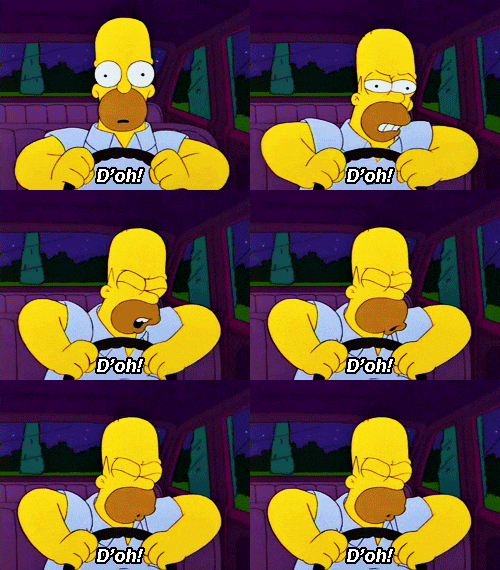
Sometimes it takes me a long spell to figure out really simple word blends. Example: the other day (and I'm talking literally, the other day, not ten years ago) I realized that Dunkin' Donuts is 'dunking' donuts. Obviously I've said the name hundreds of times, and bought countless coffees, but never having actually dunked a donut there, it had simply never occurred to me. This happened again when I was working on my sourdough starter which was given to me by my only new friend, and I stopped mid stirstroke and said out loud, SOUR. DOUGH. Dough that is sour. ahghaghahghaghagh.
the simpsons animated GIF

Cue the same scenario as I'm reading this book. 'Offred. What a weird name. It's almost like spelling 'offered' wrong. Ofglen is weird, too. Why do all the handmaidens' names start with 'Of'? So weird. 
[100 PAGES LATER]
OHHHHHHHHH. Of. Like of so-and-so. As in his. Belonging to him. Him being the name of the husband they are handmaid to. 


Common themes in dystopias
Having read quite a few dystopias in my day (that sounds like a Very weird start to a snobby professor's lecture - "I've read Many a Dystopia in MY day...), I thought I would assemble a list of common themes for you. Get. Excited. 

FYI, dystopias are heavily represented on my list, and in my non-list reading choices. Here are the ones I've read so far:

Included on my blog list
  • 1984, George Orwell
  • Animal Farm, George Orwell
  • Lord of the Flies, William Golding
  • Brave New World, Aldous Huxley
  • Atlas Shrugged, Ayn Rand
  • A Clockwork Orange, Anthony Burgess
  • Fahrenheit 451, Ray Bradbury
  • The Stand, Stephen King
  • The Trial, Franz Kafka
  • The Handmaid's Tale, Margaret Atwood
Not on my blog list, but read during the time I've been blogging
  • Hunger Games trilogy, Suzanne Collins
  • Divergent series, Veronica Roth
  • The Giver, Lois Lowry
Apparently, we like dystopias. What's your favorite dystopian novel? It's also worth noting that all but one of the books listed above were written in English. So apparently English speaking authors are ParTicularly obsessed with the future devolution of society. (Don't you love my Super random analysis? My quant professors are shouting in my ear, "correlation does Not equal causality!!!!!" ahgahghagaghag #youdontownme  #idonthavetolistentoyouanymore (handsoverears) ) 

Common themes
  • Absence/removal/miseducation - dystopias often center around the removal of something that we used to take for granted, as well as the removal of something explicitly to subjugate or disenfranchise a group or groups of people. In The Handmaid's Tale, women are the dominated group, and they are no longer allowed to own property, work for a living, read, or write. But we don't need a fictional dystopia for that. It reminded me of a line from To Kill a Mockingbird:
"Until I feared I would lose it, I never loved to read. One does not love breathing."
  • Horrible food - apparently, bad food is as much of a prerequisite for dystopias as it is for college campuses across the country (aHem - Haverford). It contributes to the generally demoralizing aspect, and it also speaks to the 'absence' piece above (rationing, scarcity, etc.) The handmaids are generally fed fairly well, though, since they are the BABYMAKERS. I loved the scene where Offred slowly and joyfully eats a soft-boiled egg. My mom used to soft-boil eggs for me when I was little, and she'd cut up the toast in strips and we would crack the shell together and scoop out the innards. We had a bunch of little egg cups in our china closet, and Offred speaks fondly of her 'blue china egg cup' and says, "Pleasure is an egg." I know just what you mean, girl. :0)
  • Suicide preferable to death - dystopias are defined as 'an imagined place or state in which everything is unpleasant or bad, typically a totalitarian or environmentally degraded one'. One of the first lines Offred writes in her description of her new room at the Commander's house is "They've removed anything you could tie a rope to." Mmmhm, nice and Dark, just how I like my coffee. ;) This is practically a requirement for dystopias - if death isn't desirable, it's probably not dark enough. (Cough Cough - NIGHTLOCK BERRIES, anyone? Peeta? Katniss? Any takers?)
  • Violence/torture as a lesson/control - this hardly needs explanation. What better way to dominate and control a group of people than to torture them any time they step out of line? 
  • Book burning - referenced in The Handmaid's Tale, and the main subject of one of the books on this list. That's right, you guessed it, THE LORD OF THE FLIES! haghagha oh wait. That's not right, is it?
  • Faked news - Oooh, how else can we confuse people and disenfranchise them? We won't let them know what is going on! Ever! Better yet, we'll just Make Things Up. This one comes up quite often, and is deeply disturbing. Can you imagine turning on the news in the morning and thinking to yourself, well, there's a 30% chance that anything they're saying is true. Oh wait, that's Fox News! 
aNd Now for Something Completely Different - more random thoughts, in no real order...

Particicution
Margaret Atwood makes up this word to represent the collective murder of a person by a group. I suppose group stoning would be the closest real-life referent. In one scene, the handmaids are asked to collectively kill a man for his alleged crimes against women and the state. It immediately reminded me of a chapter in For Whom the Bell Tolls, which was probably the most difficult scene I've ever had to read. A group of villagers collectively (and proactively, as in, we'll kill you before you can kill us) execute their fellow villagers in the Spanish Civil War, by attacking them with common farm tools and pushing them off a cliff, and the scene is grisly and harrowing. Perhaps the most provocative question it raises is this - if everyone participates, who is to blame? 

"All novels are letters aimed at one person" - Stephen King, On Writing
I've always loved this Stephen King quote, and I find it really apt. This line from the book made me think of it:
"You don't tell a story only to yourself. There's always someone else. A story is like a letter. Dear You, I'll say. Just you, without a name."
--"By telling you anything at all I'm at least believing in you, I believe you're there, I believe you into being. Because I'm telling you this story I will your existence. I tell, therefore you are." Sometimes I forget that a book requires a reader. It is a conversation, and just as you cannot read without a book, a book has no meaning without a reader to read it. 

On smells
One of my favorite things about literature is when it pushes the imagination beyond the literal. Here are some great lines about the smell of something that doesn't explicitly have a smell:
  • "Caddy smelled like trees in the rain." Faulkner, The Sound and the Fury
  • On Serena Joy during the ceremony: "The smell of her crying spreads over us and we pretend to ignore it." Atwood, The Handmaid's Tale
  • On the commander: "At least he's an improvement on the previous one, who smelled like a church cloakroom in the rain; like your mouth when the dentist starts picking at your teeth; like a nostril." Atwood, The Handmaid's Tale
  • "Everything was dead quiet, and it looked late, and smelt late. You know what I mean - I don't know the words to put it in." Mark Twain, The Adventures of Huckleberry Finn
On Fels
"The high school is old, the stalls are wooden, some kind of chipboard. I go into the second one from the end, swing the door to. Of course there are no longer any locks." The state of disrepair in the bathrooms at the handmaids' training center reminded me of Fels, the high school I worked at in Philadelphia. The stalls in the girls' bathroom were all too short, so you could look over and see the person next to you, and usually only one stall had a working door. There were never any paper towels, and you often had to go scouting if you wanted more than a scrap of toilet paper. I guess Fels was its own little present-day dystopia.

Let's play a GAME. 
The Commander's games of Scrabble with Offred were one of my favorite parts of the book. It's so delightfully unexpected, because you think maybe it will be something mean, or kinky, or bizarre, and then it's... SCRABBLE. (or, as my students at Fels liked to call it, Scramble. I'm gonna call you Murder.) Here are a few snippets from The Scrabble Series:

-- The Commander, to Offred: "I'd like you to play a game of Scrabble with me."

-- Offred's response: "Now it's forbidden, for us. Now it's dangerous. Now it's indecent. Now it's something he can't do with his Wife. Now it's desirable...It's as if he's offered me drugs." No, I'm not into meth. I do Scrabble.

"We play two games. Larynx, I spell. Valance. Quince. Zygote. I hold the glossy counters with their smooth edges, finger the letters. The feeling is voluptuous. This is freedom, an eyeblink of it. Limp, I spell. Gorge. What a luxury. The counters are like candies, made of peppermint, cool like that. Humbugs, those were called. I would like to put them in my mouth. They would taste also of lime. The letter C. Crisp, slightly acid on the tongue, delicious."

-- Offred, imagining them getting in trouble: "Caught in the act, sinfully Scrabbling. Quick, eat those words." These are my favorite lines in the book.

-- The Commander, getting boozy during Scrabble: "Sometimes after a few drinks he becomes silly, and cheats at Scrabble. He encourages me to do it too, and we take extra letters and make words with them that don't exist, words like smurt and crup, giggling over them." heheheehehehe smurt! crup!

Now it's time for Everyone's favorite section - NEW WORDS!


riffle - turn over something, especially the pages of a book, quickly and casually (did you know there's 'rifle' and 'riffle', both verbs? I know, #confusing)

curio - a rare, unusual, or intriguing object (this makes me think of the word mercurial)

peccadillo - a small, relatively unimportant offense or sin (I always think this is an animal - but I guess that's the ARMAdillo ;)

filch - to pilfer or steal (something, especially a thing of small value) in a casual way (hehee, isn't J.K. Rowling CLEVEr? she's so clever.)

semaphore - a system of sending messages by holding the arms or two flags or poles in certain positions according to an alphabetic code (see image) (I definitely thought a semaphore was part of a dress. Not sure where that thought came from. Thoughts, anyone?)

Passages I found ParTicKelarly Pleasing:
  • On handmaid indoctrination in an old school gym: "Dances would have been held there; the music lingered, a palimpsest of unheard sound, style upon style, an undercurrent of drums, a forlorn wail, garlands made of tissue-paper flowers, cardboard devils, a revolving ball of mirrors, powdering the dancers with a snow of light."
  • "Where I am is not a prison but a privilege, as Aunt Lydia said, who was in love with either/or."
  • "I hunger to commit the act of touch."
  • "I feel like cotton candy: sugar and air. Squeeze me and I'd turn into a small sickly damp wad of weeping pinky-red."
  • "Sanity is a valuable possession; I hoard it the way people once hoarded money. I save it, so I will have enough, when the time comes."
  • "Given our wings, our blinkers, it's hard to look up, hard to get the full view, of the sky, of anything. But we can do it, a little at a time, a quick move of the head, up and down, to the side and back. We have learned to see the world in gasps."
I'll leave you with this line from one of Offred's flashbacks:
"I held the cat up against my chest so I could feel her purring against my throat."

I like to do this with Suzy sometimes - well, she's a little tubby (but NOT CHUNKY, OK, mean vet lady?) so I usually smush my ear up to her chest while she's curled up in a ball. I love to feel the vibrations and the dull roar echoing through her little bones.

I finished this book a while ago, but have had a hard time motivating to post about it. I will dutifully reread Reparation, though I read it once already and can't say I really liked it. But join me if you will! We're almost down to the final ten! Happy Friday, friends!