A note on this blog's organization

Since I first started this blog, I've read well over 600 books. I decided to organize them by sections, so to navigate to specific blog entries, review the sections below. To look for a specific book, try typing the book title or author's name in the search bar at the top left of this blog.

Friday, February 20, 2015

I can't do chatting.

The Curious Incident of the Dog in the Night-Time by Mark Haddon

Spoiler Alert: Plot Summary
The Curious Incident of the Dog in the Night-Time tells the story of the singular Christopher Boone, a 15-year old British boy with behavioral differences, and his quest to solve a mystery, during the course of which he ends up discovering a very great deal about himself. The book opens with Christopher happening upon the neighbor's dog, Wellington, who has been stabbed to death with a pitchfork. Christopher sets out to determine who killed Wellington, and in the process learns some dark secrets about his father, his mother, and the circumstances of their separation. Over the course of the novel, Christopher narrates his adventure for us, sharing intimate pieces of his investigation and the unique ways in which he (and his brain) functions. It is a story about exploring the unknown, uncovering painful truths, and above all, celebrating the rare attributes that constitute a beautiful (albeit a bit unusual) human being and his brilliant brain.
Spoiler Over: Continue Here

I read this book once before, though I can't pinpoint exactly when, or what inspired me to do so. In any case, I think I found it a bit odd, but liked it overall. This time around, I really enjoyed it. Like so many of the books on this list, it felt truer to me on second reading, and it felt like I was more primed to read it at this age and stage of my life than I was the first time around. If you haven't read it, I recommend it, though it is definitely not for everyone, and it takes some mental adjustment to appreciate [code for: my mother and sister, who often share my reading tastes, did not care for it - d'as ok! it's not for everybody!].

I thought it would be fun to share an abbreviated chronology of the turn of events so that You could enjoy the mystery, Too! [NB: This means that the entire post is, in itself, a plot spoiler. Apologies! Come back to it later if you think you'd like to read the book first yourself!]

Scene 2: In Which Christopher finds Wellington dead [growing up, my sisters and I read this series of books called "Dealing with Dragons" [CaN't believe I pulled that out. STEEL TRAP, ladies!] by Patricia Wrede [oh, you haven't heard of it? maybe that's because we were HUGE fantasy fans - if there was a book about a dragon, a witch, a sorcerer, or starring an animal as a lead character, WE READ IT. "If you made a movie, Tad, I've seen it."] and each chapter starts out with "In Which" - for example, "Chapter 1: In Which Cimorene Refuses to be Proper and Has a Conversation with a Frog". So for quite some time, we would make up chapters for our lives with ridiculous banalities like "Chapter 17: In Which Meredith Tries to Wash her Hair but Discovers Diana Has Used Up All of the Conditioner". #thatnerdylife #cantstopwontstop

Aaaaaaaaaaaaaaand, we're back. [FYI, the scenes are incremental primes, in honor of the Christopher's convention for chapter numbering in the book] 

Scene 2 (for realz now): In Which Christopher finds that Wellington is, in point of fact, an Ex-Dog, and he is not simply pining for the fjords
  • "I decided that the dog was probably killed with the fork because I could not see any other wounds in the dog and I do not think you would stick a garden fork into a dog after it had died for some other reason, like cancer, for example, or a road accident. But I could not be certain about this." This is an example of the way Christopher narrates and thinks - a bit like stream of consciousness, but always with a clear logic. I found it amusing, and often unintentionally dry and witty. 
  • "He was leaking blood from the fork holes." ahh yes, the classic blood leaking.
Cue the local policeman who stumbles upon Christopher hugging the ex-Wellington:

Policeman: "Why were you holding the dog?"
    Christopher: "I like dogs."
Policeman: "Did you kill the dog?"
    Christopher: "I did not kill the dog."
Policeman: "Is this your fork?"
    Christopher: "No."

Amazing exchange. Is this your fork? 'Your cigarettes fell out of your pocket.' 'Those aren't mine. I don't smoke.' 

Scene 3: In Which Christopher lets us know how he Really feels about pesky metaphors like "We had a real pig of a day" and "They had a skeleton in the cupboard.": 
  • "I think it should be called a lie because a pig is not like a day and people do not have skeletons in their cupboards." too True, Christopher. At least I Hope people don't have skeletons in their cupboards!
  • "My name is a metaphor and it means Carrying Christ": "Mother used to say that it meant Christopher was a nice name because it was a story about being kind and helpful, but I do not want my name to mean a story about being kind and helpful. I want my name to mean me." I thought this was such a piercingly sweet statement. Our names often represent all kinds of things to the parents that name us (reminders of living or deceased family members, ideals, religious icons) but I think in the end, we all want our names to just mean us, the very essence of who we are. 
Scene 5: In Which Christopher enlightens us on why he doesn't like to hypothesize on what could have happened in a scenario
  • "If I start thinking about something which didn't happen I start thinking about all the other things which didn't happen. For example, this morning for breakfast I had Ready Brek and some hot raspberry milk shake. But if I say that I actually had Shreddies and a mug of tea* I start thinking about Coco Pops and lemonade and porridge and Dr Pepper and how I wasn't eating my breakfast in Egypt and there wasn't a rhinoceros in the room and Father wasn't wearing a diving suit and so on..."
*But I wouldn't have Shreddies and tea because they are both brown.

Christopher's strict color preferences are fantastic - I know they're a real representation of his behavioral differences, but I also found them delightful in the literary sense. And it's true - how do you Know I Didn't eat my breakfast in Egypt with a rhinoceros in the room? I could have been sick all night! Especially if I wanted to! Hard to say where imagination ends...

Scene 7: In Which Christopher explains his system for determining the quality of a day

"In the bus on the way to school next morning we passed 4 red cars in a row, which meant that it was a Good Day, so I decided not to be sad about Wellington.
    Mr. Jeavons, the psychologist at the school, once asked me why 4 red cars in a row made it a Good Day, and 3 red cars in a row made it a Quite Good Day, and 5 red cars in a row made it a Super Good Day, and why 4 yellow cars in a row made it a Black Day, which is a day when I don't speak to anyone and sit on my own reading books and don't eat my lunch and Take No Risks."

This system for days was one of my favorite motifs in the book. It also makes total sense to me! There are all kinds of things I look at in the morning (is the sun shining? did I slip on the ice? was there traffic on the way to work? did I get a good parking spot?) that I use to determine whether my day will be good or not, and they're just as arbitrary as Christopher's car-counting system. So maybe I'll try his way! I also love the "TAKE NO RISKS" part. It's hilarious to think about consciously spending a day intentionally taking No risks. Want to go for a car ride? No. Want to go horseback riding? NO. Today is a day to take no risks. Christopher also explains that if he has 2 black days in a row, he's allowed to close his eyes the whole ride to school so that he doesn't see the cars and he can reset the system. Which I think is a very logical (and practical) back door to his system. [Especially since one would start to get very hungry!]

Scene 11: In Which Christopher's father tells him that his mother is very sick and Christopher makes a card for his mother "in hospital" [in quotes because Mother is not sick (and does not die as Christopher's father tells him) but has actually left them to live with a man in London]
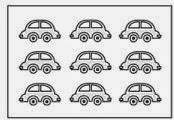

"I did it at school with Mrs. Peters, who does art, and it was a lino cut, which is when you draw a picture on a piece of lino and Mrs. Peters cuts round the picture with a Stanley knife and then you put ink on the lino and press it onto the paper, which is why all the cars looked the same, because I did one car and pressed it onto the paper 9 times. And it was Mrs. Peters's idea to do lots of cars, which I liked. And I colored all the cars in with red paint to make it a Super Good Day for Mother." Possibly the cutest moment in the whole book. 

Scene 13: In Which Christopher explains why detective work is hard ["My body's nobody's body but Mine..."] 
  • "Talking to strangers is not something I usually do. I do not like talking to strangers. This is not because of Stranger Danger, which they tell us about at school, which is where a strange man offers you sweets or a ride in his car because he wants to do sex with you. I am not worried about that. If a strange man touched me I would hit him, and I can hit people very hard." Haghaghaghaghaghagh. Christopher is not worried, OK? He's got this on lockdown. No strangers with sweets trying to do sex with Him!
Scene 17: In Which we are introduced to Christopher's pet rat, Scabbers Tony
  • "Most people don't like rats because they think they carry diseases like bubonic plague. But that's only because they lived in sewers and stowed away on ships coming from foreign countries where there were strange diseases. But rats are very clean. Toby is always washing himself. And you don't have to take him out for walks. I just let him run around my room so that he gets some exercise. And sometimes he sits on my shoulder or hides in my sleeve like it's a burrow." So, true story. One Christmas, my oldest sister bought 2 pet rats for my middle sister, because at the time, she couldn't have large furry pets, and we thought Diana might be able to get behind the idea of pet white 'fancy rats' (actual breed name). To her credit, she got as far as naming them (one was Captain Cynthia - can't remember the other - anyone? Bueller?) before she donated them to the local high school's biology department to keep as classroom pets. Sorry, Christopher, not everyone can get behind rats. The tails were hard to stomach.
Policeman: "Jesus. What is that?"
And I looked down and I said, "That's my pet rat, Toby," because he was looking out of my pocket at the policeman.
 And the policeman said, "A pet rat?"
And I said, "Yes, a pet rat. He's very clean and he hasn't got bubonic plague."
 And the policeman said, "Well, that's reassuring."
ahaghahgahgahghaghagagh. 

Scene 19: In which Christopher almost has tea with his neighbor, Mrs. Alexander

Christopher, on being offered Battenberg cake (see picture): "I think I'd like the pink squares but not the yellow squares because I don't like yellow. And I don't know what marzipan is, so I don't know whether I'd like that.

Mrs. Alexander: "I'm afraid marzipan is yellow, too. Perhaps I should bring out some biscuits instead. Do you like biscuits?"

Christopher: "Yes. Some sorts of biscuits."

Mrs. Alexander: "I'll get a selection."  I thought this was such an adorable exchange. Mrs. Alexander just rolls with the punches where Christopher's specific rules are concerned, and she's one of the only people in the book who doesn't challenge or question his preferences or behaviors. Don't like yellow? Righty-ho then, a different color it is!

Scene 23: In Which Christopher tells us how he feels about the epithet 'special needs'
  •  "Siobhan (one of Christopher's teachers) said we have to use those words because people used to call children like the children at school spaz and crip and mong, which were nasty words. But that is stupid too because sometimes the children from the school down the road see us in the street when we're getting off the bus and they shout, "Special Needs! Special Needs!" But I don't take any notice because I don't listen to what other people say and only sticks and stones can break my bones and I have my Swiss Army knife if they hit me and if I kill them it will be self-defense and I won't go to prison." Like I said, Christopher has this on lock. Maaaaaybe take it down a notch, though, killer. ;)
Scene 29: In Which Christopher is caught in a rhetorical trap after his father finds out he has been detecting ADO (Against Dad's Orders, OBvi)

Christopher's Dad: "Is this true? Did you talk to Mrs. Alexander?"
"Yes."
"Holy fucking Jesus, Christopher. How stupid are you?"
   This is what Siobhan says is called a rhetorical question. It has a question mark at the end, but you are not meant to answer it because the person who is asking it already knows the answer. It is difficult to spot a rhetorical question." Hahgaghaghagh yes. It Can be Tricksy, Christopher!

Scene 31: In Which Christopher must venture out on his own for the first time, like Denver

"I had to get out of the house. Father had murdered Wellington. That meant he could murder me, because I couldn't trust him, even though he had said "Trust me", because he had told a lie about a big thing."

"And I had never been anywhere apart from the shop at the end of the road on my own. And the thought of going somewhere on my own was frightening." I was struck by the symmetry with Beloved on this reading, and the way in which Christopher's fear of his father is ignited by an act of violence, much like Denver's fear and mistrust of Sethe.

Scene 37: In Which Christopher embarks on an adventure to London after finding out his mother is Not dead and his father made Wellington an ex-Wellington (in a fit of rage at being spurned by the woman who owns Wellington (with whom he happens to be having an affair))
  • "And then there was no one else in front of the window and I said to the man behind the window, "I want to go to London," and I hadn't been frightened when I was with the policeman but I turned round and I saw that he had gone now and I was scared again, so I tried to pretend I was playing a game on my computer and it was called Train to London and it was like Myst or The 11th Hour, and you had to solve lots of different problems to get to the next level, and I could turn it off at any time." OMG MYST. OMG MYST. Now I just want to go play Myst all day. Anyone? Anyone? I'm still trying to figure out how to connect those wooden paths on the island. 
Scene 41: In Which Christopher shares his opinion on vacations being vastly overrated
  • "Siobhan says people go on holidays to see new things and relax, but it wouldn't make me relaxed and you can see new things by looking at earth under a microscope or drawing the shape of the solid made when 3 circular rods of equal thickness intersect at right angles. And I think that there are so many things just in one house that it would take years to think about all of them properly. And also, a thing is interesting because of thinking about it and not because of being new. For example, Siobhan showed me that you can wet your finger and rub the edge of a thin glass and make a singing noise. And you can put different amounts of water in different glasses and they make different notes because they have what are called different resonant frequencies, and you can play a tune like Three Blind Mice. And lots of people have thin glasses in their houses and they don't know you can do this." See, everyone!? Next time you think you need to run off to Cancun or Paris, just dig around in your house - I bet you have thin glasses in your house and you Don't Even Know It. 
Scene 43: In Which Christopher arrives at his not-dead Mother's flat in London and addresses her and her stunned boyfriend
  • "I stood up and I said, "You weren't in, so I waited for you." Classic. OH HI! Guess what? I'm HEEEEEEEEre! Sooprize!
Scene 47: In Which Christopher begins to (begrudgingly) reconcile with his father
  • "So I sat on the sofa and he sat on the armchair and Mother was in the hallway and Father said, "Christopher, look... things can't go on like this. I don't know about you, but this... this just hurts too much. You being in the house but refusing to talk to me... You have to learn to trust me... And I don't care how long it takes... If it's a minute one day and two minutes the next and three minutes the next and it takes years I don't care. Because this is important. This is more important than anything else.'   And then he said, "Let's call it... let's call it a project. A project we have to do together. You have to spend more time with me. And I... I have to show you that you can trust me. And it will be difficult at first because... because it's a difficult project. But it will get better. I promise." I recently watched the first few episodes of Parenthood, in which one of the couples discovers that their son, Max, has Asperger's. They've noticed changes in his behavior over the years, but the most recent conundrum is that Max will only wear a pirate costume to school, and is starting to get bullied. Max meets with a specialist who officially diagnoses him, and when the distraught parents ask how to get him out of the costume, the specialist tells them that they need to 'get down on his level' and climb into his world as a first step. The episode ends with a triumphant scene of Max's generally stiff and stodgy dad careening into the backyard wearing an adult pirate costume, and the two of them begin to duel with plastic swords. I can't imagine how difficult it would be to feel different, like Christopher or Max, or to love Christopher or Max, and want only the best, warmest, most comfortable life for them. I found both of these moments poignant because they speak to such unconditional parental love in the rawest moments of human connection.
As I was reading the book, I began to compile a list of ways in which Christopher and I are alike. Here's the final list:
  • We have a fear of meeting strangers: "I do not like strangers because I do not like people I have never met before. They are hard to understand. It takes me a long time to get used to people I do not know." 
  • We don't like small talk:  
Mrs. Alexander: "It's very nice of you to come and say hello."
  I didn't reply to this either because Mrs. Alexander was doing what is called chatting, where people say things to each other which aren't questions and answers and aren't connected. I was about to turn and walk away when she said, "I have a grandson your age."
     I tried to do chatting by saying, "My age is 15 years and 3 months and 3 days." 

and later...
Mrs. Alexander: "'Don't worry, I'm not going to tell your father, because there's nothing wrong with having a chat. Having a chat is just being friendly, isn't it.' 
Christopher: 'I can't do chatting.'"Haghahgahga. Neither can I, Christopher! Neither can I! (Aye, sister, SO did I!) I often have to mentally prompt myself to think of mundane questions to ask other people, and I find small talk immensely uncomfortable. 
  • Moving furniture makes us nauseous [or is it NauseAted, grandma?] "It is permitted to move the chairs and the table in the kitchen because that is different, but it makes me feel dizzy and sick if someone has moved the sofa and the chairs around in the living room or the dining room. Mother used to do this when she did the hoovering, so I made a special plan of where all the furniture was meant to be and did measurements and I put everything back in its proper place afterward and then I felt better." I got my first real office this year at work, and it took me nearly two weeks to settle on how I wanted to orient my desk. But each time I moved it, I felt dizzy and a little uncomfortable. It took me nearly 2 months to feel like it was truly settled. 
  • We both wanted to be astronauts when we were younger, but we both knew it would never work out.        Christopher - "I think I would make a very good astronaut."
  • Both like white noise (We both like Soup...): "On the fifth day, which was a Sunday, it rained very hard. I like it when it rains hard. It sounds like white noise everywhere, which is like silence but not empty." I've started listening to 'rainy mood', which is a website that just plays rain sounds on repeat, when I'm reading, or when I have a long project at work. I find it exceedingly soothing. 
  • Subway crowds = our own personal hell 
"There were lots of people on the train, and I didn't like that, because I don't like lots of people I don't know and I hate it even more if I am stuck in a room with lots of people I don't know, and a train is like a room and you can't get out of it when it's moving.
...
Then I went out of the toilet and I saw that opposite the toilet there were two shelves with cases and a rucksack on them and it made me think of the airing cupboard at home and how I climb in there sometimes and it makes me feel safe. So I climbed onto the middle shelf and I pulled one of the cases across like a door so that I was shut in, and it was dark and there was no one in there with me and I couldn't hear people talking so I felt much calmer and it was nice." When I lived in Arlington, Virginia, I lived off of the Orange metro line, and was therefore a lucky participant in the "ORANGE CRUSH" during rush hour, aka being smothered daily by other people (and their body odor) on the way to work. It may have been 3 degrees on my way to work today, and I may have felt my body shutting down during the commute which is too short for the heat to start working but guess what? No one else was in the car sitting on my face or obnoxiously talking politics or smushing me up against a glass door. So... #winning. This story also reminded me of when my sisters and I lost my cat, Suzy Chubsters, at a cabin we were staying at for New Year's. After several hours, we located her from her tiny squeak-meows, only to discover that she had climbed on top of some skillets in a cupboard when we pulled out a pan to bake cinnamon buns. Because I'm a crazy cat lady, sometimes I leave the tea-towel drawer open in my kitchen so that Suzy can climb into and behind it, because she likes to lurk in the dark space back there for hours on end. #iknow,mylifeisawesome #youknowyou'rejealous
  • We are both terrified by the sound of the subway train arriving: "And then there was a sound like people fighting with swords and I could feel a strong wind and a roaring started and I closed my eyes and the roaring got louder and I groaned really loudly but I couldn't block it out of my ears and I thought the little station was going to collapse or there was a big fire somewhere and I was going to die." Preeetty much how I felt every morning of the Orange Crush era.
I'd like to leave you with this final tidbit from charismatic Christopher's brain: 

"When I was asleep I had one of my favorite dreams. Sometimes I have it during the day, but then it's a daydream. But I often have it at night as well.
  And in the dream nearly everyone on the earth is dead, because they have caught a virus. But it's not like a normal virus. It's like a computer virus. And people catch it because of the meaning of something an infected person says and the meaning of what they do with their faces when they say it, which means that people can also get it from watching an infected person on television, which means that it spreads around the world really quickly.
...
   And eventually there is no one left in the world except people who don't look at other people's faces and who don't know what these pictures mean

and these people are all special people like me.
...
And I can go anywhere in the world and I know that no one is going to talk to me or touch me or ask me a question. But if I don't want to go anywhere I don't have to, and I can stay at home and eat broccoli and oranges and licorice laces all the time, or I can play computer games for a whole week, or I can just sit in the corner of the room and rub a 1 pound coin back and forward over the ripple shapes on the surface of the radiator."

What do you dream about? I'm not sure I'd want a whole world of people with my particular class of personality/mental makeup, but there's something so painfully poignant about Christopher's dream. Sure, it sounds like a nightmare for many (after all, it starts with a virus that basically triggers an apocalypse) but it gets at the idea of how wonderful it is to find a place where you can be you, in whatever way feels comfortable. 

Rubbing the coin on the ridges of the radiator reminded me that when I was younger, I had a pink 'blankie' covered with different patches of fabric and sewn over in places where it had ripped or gotten thin (and in one place it was even burned because I accidentally left it on top of my lamp - safety first, kids!) But anyway, I loved that blankie, and my favorite thing to do at the end of the day was just to rub my fingers along the edges - one side had a smooth, satiny binding, and one side was ragged, and felt scratchy and soft at the same time, and the rest was ridged all the way around. I think in my dream apocalypse, there are books everywhere, but people, too, and you can talk to the people if you want, but you can also just go into your separate velvet-covered reading rooms and snuggle into couches with hot cocoa and read silently on your own. I can do without the licorice laces, but endless bagels would be superb. And when it's time to go to sleep, I would pull my blankie out (no sneaking necessary - it's my dream, remember? so it's Cool to have a blankie when you're 28 there) and just serenely knead along the edges, switching from soft to ragged to smooth, over and over, until I drifted off to pleasant dreams. 

Well folks, we're down to the final six! Join me for Wan Conflagration if you care or dare!

Sending you thoughts of warm cocoa, soft velvet reading couches, and the land of pleasant dreams. 

Thursday, February 12, 2015

He can neither read nor write and in him broods already a taste for mindless violence.

Blood Meridian by Cormac McCarthy

Spoiler Alert: Plot Summary
Blood Meridian is a story about something. I hate to say it, but I honestly don't know what. There's a 'kid' (never gets a name - THANKS, PROUST, FOR SETTING THAT PRECEDENT) who travels around Texas, Mexico, and California in the mid to late 1800s, scalping Indians, pillaging villages, et Cetera, et CeterA, et CeterAa. There are other dudes as well, most of whom are wholly unlikable and pretty awful human beings. The only female characters are whores (LiTrally - prostitutes by profession). Because obviously what other women existed back then?

I just read the Wikipedia entry intro and got this nugget:

"The role of antagonist is gradually filled by Judge Holden, a huge, intellectual man depicted as bald from head to toe and philosophically emblematic of the eternal and all-encompassing nature of war. Although the novel initially generated only lukewarm critical and commercial reception, it has since become highly acclaimed and is widely recognized as McCarthy's masterpiece."

And then I thought to myself, oh REAlly? (Christian voice from Clueless) Because that's SO NOT what I took away. I'm definitely still on the tepid train. I knew there was a judge, I knew he was mostly naked and waggling his privates around, and I knew that it had something to do with war. But I have to say I think that's a Beeeetttt of a stretch, folks. Are you Sure we read the Same book? Maybe there are 2 Blood Meridians. 
Spoiler Over: Continue Here

In case it wasn't clear from the spoiler alert, I hated this book. I know, Grandma Rose, hate is a strong word. If it makes you feel better, I'll say I severely disliked this book. [I did not ESteem this book. I did not greatly adMire this book.] I felt that it lacked any sort of motivating plot, it told a story that felt old to me, and it tried to wallow (unsuccessfully in my opinion) in the gory, grotesque debauchery of war. Maybe that was McCarthy's big ole' ironic political statement there, but I MISSED IT. I've said it before, and I'll say it again, but I'm a pretty smart gal and I've read a LOT of books by now, and if I'm not catching something, you can bet your bottom dollar that the average reader sure as hell isn't catching it either.

That said, here are my thoughts, in no real order:

- Superdumb "Helpful" plot outline chapter headings
Each chapter starts out with this weird abbreviated summary of what's going to happen in the chapter. I found this (a) annoyingly revelatory (b) odd (c) obnoxious (d) ALL OF THE ABOVE. I didn't get it, as a device or as a statement, and I started skipping them because Why would I want to KNow what happens before I've read the Chapter?? Hello, I'm not Laura Morris Stengel, I don't read the last page of a book first. ;)  

- Fragments fragments are no fun fragments aren't for Everyone
McCarthy seems to be a big fan of the 'I'm going to use my poetic license to write weird nasty fragment sentences' and I'm NOT in favor of this. The occasional fragment is fine by me if it has meaning, or if you're making a statement, but I felt like it was just disjointed and lazy. Some of the writing felt Hemingway-esque, but not in a good way. Like it was trying too hard to be cool. 

- Go on, runon, keep on running on [dun dun dun dun Dun dun chachachacha dun dun dun dun DUN cacaCacacaca]
McCarthy is also a big fan of the long sentence that seems to go nowhere and sounds kinda sorta pretty and lovely in the middle and then ends and you're left feeling confused and befuddled. [SORT OF like the sentence I just wrote. Isn't that neat?] Case in point: "His origins are become remote as is his destiny and not again in all the world's turning will there be terrains so wild and barbarous to try whether the stuff of creation may be shaped to man's will or whether his own heart is not another kind of clay." Lost. I got lost in that sentence. Some who wander in sentences ARE lost, McCarthy.

- I'm sorry, No hablo Espanol.
It will come as a sooPrize to NO one that 'classic' novels love to sprinkle in other languages you're just supposed to magically know. There's a lot of this in the old Russian classics, tons of French everywhere (former diplomatic language, so we May give it a pass) and in this novel, McCarthy apparently assumes we speak Spanish. And even if we don't, it's not purely necessary to understand the novel. That's what I have to assume, as he offers no translation for the loads of conversations and interactions that take place en Espanol. Well, guess what, Cormac? This gal doesn't speak Spanish. I speak French! I know some Latin. My Parseltongue is really coming along.

- Who can say the 'n' word?
I'm not going to go in depth here, as this could be quite the rabbit (or Rat) hole. Suffice it to say that I have some not so great feelings about white men using the 'n word' in literature, even if it is temporally appropriate to the historical setting. There's something that makes me squeamish about the decision to capture that period and evoke the sentiment with which the word was used, and I'm not 100% against it, but I think it has to be very carefully and sparingly used. As a general rule, I understand the need to reclaim the word by African-Americans, but am not really for any other perpetuation of the term. Then again, maybe this was supposed to be some sort of meta-opposite-I'm-using-the-word-ironically sort of thing, but AGAIN, I didn't pick up on any of that. I just heard an old white guy writing the 'n word' over and over again in a book that was published within the last three decades.

- Is this your story, Cormac?
 One of the characters in the book says (I think aptly) "a false book is no book at all'. If you've read my blog, you know that I am a big fan of the idea that the best writers find a way to write what they know. [See the Atonement post, On War section linked here for more on this philosophy]. In my opinion, this was not Cormac's story to tell. I don't know anything about him (as a rule, I don't look up authors or books until after I've read them) but I do know that he can't have gone on a scalping escapade in the 1800s if he was writing this book in 1985. This is not to say that I don't think great writers can imagine parts of their fiction, but the whole narrative (ironic or not) felt false to me. I think that's why the lyrical brilliance felt disconnected.

- Who needs quotation marks? I DO. 
Cormac apparently thinks it's cool not to use quotation marks. I know I've slipped into calling him Cormac, which feels a bit informal. This is probably because there's a Cormac who works at the IT and data section for the national branch of my company and I heard about him for years before I met him (cool, not particularly amazing, but pleasant) so the name is very amusingly infamous to me. AAAAnd back to the topic at hand. The whole book is written without quotes, so sections read like this one:

What do you want to do?
I dont know. Lead him awhile. See how he does.
He aint goin to do.
I know it.
We could ride and tie.
You might just keep ridin.
I might anyway.

I supPose there is an argument to be made for this somehow loosening the flow of dialogue, or playing with the style of conversation, oR blah blah blah INSERT HOITYTOITYREASONING HERE but I just found it Really Really Annoying. I felt like I was tripping over the pages, and I could never remember who was talking when, and eventually I just stopped caring entirely. 

- Pretty, but GROSS
If this book had an epithet, this is what I would choose. Much of the book's language is stylistically beautiful, but also just grotesque. Again, aPParently we were supposed to KNow this grotesquery was IRONICAL but even if it is, it's still an unpleasant reading experience for people like me. Here's an example - in this case, someone has just been bitten by a vicious vampire bat. 
"Sproule was clawing at his neck and he was gibbering hysterically and when he saw the kid standing there looking down at him he held out to him his bloodied hands as if in accusation and then clapped them to his ears and cried out what it seemed he himself would not hear, a howl of such outrage as to stitch a caesura in the pulsebeat of the world."

- I'm sorry is Tabernacled a verb now? I must politely disagree.
My sisters and I have a very bad habit of scribbling notes in our programs on the somewhat rare occasions we attend church. During the Christmas sermon this past year, the pastor seemed to decide that 'tabernacled' was a verb, and that it was a KEY word in the sermon. The sister on my right started to aggressively scribble "NOT A VERB NOT A VERB NOT A VERB" each time it resurfaced, and hilariously, the sister on my left pointed it out separately a few minutes later. At this point, I don't really care if it is a verb. I don't like it. So there! Guess who also thinks it's a verb? That's right, you guessed it - CORMAC!

"Whether in my book or not, every man is tabernacled in every other and he in exchange and so on in an endless complexity of being and witness to the uttermost edge of the world." No. No man is tabernacled. NOT A VERB NOT A VERB NOT A VERB. 

Here are what I will admit are a few nice turns of phrase:
  • "The shadows of the smallest stones lay like pencil lines across the sand and the shapes of the men and their mounts advanced elongate before them like strands of the night from which they'd ridden, like tentacles to bind them to the darkness yet to come." I haven't read a book with such great desert scenes since Dune, and it made me nostalgic for some makers and spice.
  • "Tethered to the polestar they rode the Dipper round while Orion rose in the southwest like a great electric kite." Orion is my favorite constellation. My mom pointed it out to me a long time ago, and it still pleases me that when I get out of my car after work and I look up at the sky, I see the same Orion she sees nearly 500 miles away. 
  • "That night they sat at the fire like ghosts in their dusty beards and clothing, rapt, pyrolatrous."
  • "The bear had carried off their kinsman like some fabled storybook beast and the land had swallowed them up beyond all ransom or reprieve."
  • "A lobeshaped moon rose over the black shapes of the mountains dimming out the eastern stars and along the nearby ridge the white blooms of flowering yuccas moved in the wind and in the night bats came from some nether part of the world to stand on leather wings like dark satanic hummingbirds and feed at the mouths of those flowers." Ok, I'll admit, this sentence is lovely. It also reminds me of Carlsbad caverns in New Mexico, when the bats all emerge at dusk and circle hypnotically above the entrance and then flee to Texas and forage for their feast. 
You're never too old to learn new words! Besides, this book should be useful for SomeFink!

anchorite - a religious recluse

pilotbread (aka hardtack) - hard dry bread or biscuit, used for sustenance in the absence of perishable foods [OH I GET IT, LEMBAS BREAD. why didn't you just say so?]

bungstarter - a wooden mallet used for opening the bung (or stopper) of a cask

bloodbat - bats whose primary food source is blood (shameless excuse to put up a picture - SCARY, right?)

holocaust - so obviously I knew this was a word, but I never thought of it as a lower-case 'h' word. here's that definition: destruction or slaughter on a mass scale, especially caused by fire or nuclear war. from the Greek, holokauston - 'holos' 'whole' + 'kaustos' 'burn'

panicgrass - large grasses native throughout the tropical regions of the world, typically 1-3 meters tall; so named for the 'panicle' shape their flowers make

tatterdemalion - a person dressed in ragged clothing; a ragamuffin; worn to shreds [I love this word. I want this word to be a part of every day. Now, how to incorporate it...] [in trying to search for an image, I found that RagaMuffin is apparently a cat breed. And now this, for your viewing pleasure:

Lexie, the RagaMuffin cat queen from the internets  of lore 


I hope you enjoy that photo as much as I did. Also, that is apparently her name, not my decision to name her after my oldest sister ;) haghaghaghahghaggha. 

I leave you with this last nugget from good ole' Cormac. 

"There is hardly in the world a waste so barren but some creature will not cry out at night, yet here one was and they listened to their breathing in the dark and the cold and they listened to the systole of the rubymeated hearts that hung within them."

I like it most particularly because it reminds me of the Sylvia Plath line -"I took a deep breath and listened to the old brag of my heart. I am, I am, I am."

Listen to the bragging systole of your rubymeated hearts, and take pleasure in the fact that you are, you are, you are! 

Love and snowflakes! I'm off to The Inquisitive Case of the Rabbit at Twilight - NAILED it that time, I'm sure of it. 

Thursday, January 29, 2015

In the dark my name is Beloved.

Beloved by Toni Morrison

Spoiler Alert: Plot Summary
Beloved tells the story of Sethe, a woman who was enslaved on a plantation called Sweet Home in Kentucky, and her life both before and after she escapes. Sethe has a husband, Halle, and four children - two sons, Howard and Buglar, and two daughters, Denver and Beloved. We learn as the book progresses that Sethe killed her youngest, Beloved, an infant, when the plantation master came for her and her children after they escaped to Ohio to live with Baby Suggs, Sethe's mother-in-law. Halle did not make it out of Sweet Home.  Denver stays with Sethe, but Howard and Buglar leave after the spirit of Beloved begins to haunt Sethe's house, 124 Bluestone Road.  Later, the spirit comes to corporeal life, insidiously wreaking havoc on the tenuous family that Sethe has created with her only remaining child, Denver, and Paul D, a friend (now lover) from Sweet Home who finds his way to their home. The book intricately and intimately weaves together the horrors of slavery and Sethe's personal experience as a wife, a woman, a lover, and a mother. It tells a horrifically dark story with poetic brilliance, and deserves a prominent place in the collection of literary classics.
Spoiler Over: Continue Here

This book is outstanding. I read it once before, for a course I took at Haverford called 'Portraits in Black' which focused on African-American literature. I don't think I really got the book the first time around, both because I was about a decade younger (eek!) and because it has many, many layers. If you haven't read it, you should. 

That said, be warned that it is not for the faint of heart. The book deals explicitly with slavery and all of its repercussions, and it takes you face to face with the darkest side of humanity. This post will scratch at the surface of that darkness, so consider yourself forewarned.

I can't decide on how best to organize this post, so I'm going to take my lead from the book itself, and follow a semi-linear chronological structure with a little stream of consciousness sprinkled in here and there. 

NB: I refer to certain charged words from the book to stay true to its language, so know that my use of these words is in reference only, and I recognize that many of these words are no longer in 'appropriate' usage today.
- 124, a house possessed
This book has one of my all-time favorite first lines - "124 was spiteful."

I love the way the book blends the real and the mystical, treating the possession of the house as both bizarre and banal. It reminded me of Marquez's magical realism, but with a spiritual twist.
-- "Sethe and the girl Denver did what they could, and what the house permitted, for Baby Suggs. Together they waged a perfunctory battle against the outrageous behavior of that place; against turned-over slop jars, smacks on the behind, and gusts of sour air. For they understood the source of the outrage as well as they knew the source of light."
-- "Who would have thought that a little old baby could harbor so much rage?"
-- Baby Suggs, when someone suggests they leave 124: "Not a house in the country ain't packed to its rafters with some dead Negro's grief."

Paul D's arrival at 124: "Paul D tied his shoes together, hung them over his shoulder and followed her through the door straight into a pool of red and undulating light that locked him where he stood.
  'You got company?' he whispered, frowning.
  'Off and on,' said Sethe.
 'Good God.' He backed out the door onto the porch. 'What kind of evil you got in here?'
  'It's not evil, just sad. Come on. Just step through."

I love this line - "You got company? Off and on." Haghahghaghaghag. Yes, the spirit is only around Sometimes, so not really Full-time company, so to speak. It's FINE, Paul D. Just come on in. Step right on in. 

- Lives moved like checkers pieces
Toni Morrison does an incredible job weaving the various painful impacts of slavery into the everyday realities of her characters, seamlessly and simultaneously telling a story that is at once personal and historical. 
  "In all of Baby's life, as well as Sethe's own, men and women were moved around like checkers. Anybody Baby Suggs knew, let alone loved, who hadn't run off or been hanged, got rented out, loaned out, bought up, brought back, stored up, mortgaged, won, stolen or seized...What she called the nastiness of life was the shock she received upon learning that nobody stopped playing checkers just because the pieces included her children." In many spaces like this one here, I want to say something, express the deep sorrow I feel, and the raging, burning anger it brings up in me. But mostly I just want Morrison's words and her elegant capturing of such hateful behavior to be echoed so that we are all reminded that it was real. So we'll just agree to say that is enough for now. 

- Sweet Sunday-morning pleasures
Part of what makes this book so beautiful is how Morrison finds a way to share the sweetness on the flipside of each ugly perpetration of slavery. I loved this line about Halle and Sethe:
"For years they saw each other in full daylight only on Sundays. The rest of the time they spoke or touched or ate in darkness. Predawn darkness and the afterlight of sunset. So looking at each other intently was a Sunday-morning pleasure and Halley examined her as though storing up what he saw in sunlight for the shadow he saw the rest of the week."

- On Sethe and Halle's 'marriage'
When Sethe gets 'married' at Sweet Home, she is 14 years old. [Can you even imagine? I would have been married for 15 years.] Here is the story of her wedding dress:
"I guess she saw how bad I felt when I found out there wasn't going to be no ceremony, no preacher. Nothing. I thought there should be something - something to say it was right and true. I didn't want it to be just me moving over a bit of pallet full of corn husks. Or me bringing my nightbucket into his cabin. I thought there should be some ceremony. Dancing maybe. A little sweet william in my hair.
    Well, I made up my mind to have at least a dress that wasn't the sacking I worked in. So I took to stealing fabric, and wound up with a dress you wouldn't believe. The top was from two pillow cases in her mending basket. The front of the skirt was a dresser scarf a candle fell on and burnt a hole in, and one of her old sashes we used to test the flatiron on. Now the back was a problem for the longest time. Seem like I couldn't find a thing that wouldn't be missed right away. Because I had to take it apart afterwards and put all the pieces back where they were." Let's just call this another echo.

- On Sethe's first days free
 On community with the other African-American women: "One woman taught her the alphabet; another a stitch. All taught her how it felt to wake up at dawn and decide what to do with the day." What a luxury it is that we wake up each morning and decide what to do with our day. Had you realized what a luxury it was before this moment? I hadn't.

- On [corporeal] Beloved's mysterious arrival
"Forbidden public transportation, chased by debt and filthy 'talking sheets', Negroes followed secondary routes, scanned the horizon for signs and counted heavily on each other. Silent, except for social courtesies, when they met one another they neither described nor asked about the sorrow that drove them from one place to another. The whites didn't bear speaking on. Everybody knew.
    So he did not press the young woman with the broken hat about where from or how come."

- The bit
It's taken me a long time to finish reading this book, and longer to write this blog, in large part because of how difficult the subject matter is for me. On a basic level, of course, I've known about slavery for as long as I can remember. But coming to terms with its reality and its barbarity is another thing entirely. I think it is essential that we remember the horror of it, that we don't allow ourselves to selectively remember, or to collectively forget. It is our history, and we own it, and just because I'm living over a hundred years later doesn't mean that I don't hold responsibility for undoing its wrongs. It's always easy to think, oh, that's horrible, I would definitely have been an abolitionist, or I'm sure I wouldn't have owned slaves. But the reality is that a horrific crime was perpetrated systematically over decades and centuries by one people over another because of the color of their skin, and we can't ever take that back. All we can do is listen when we are told the story, and know that as painful as it is to remember, it is unspeakable to forget.

That said, here's one of the passages I found most difficult to read, but which I think it is essential to share, on Paul D having 'the bit' placed in his mouth as punishment:
   Sethe, thinking to herself: "He wants to tell me, she thought. He wants me to ask him about what it was like for him - about how offended the tongue is, held down by iron, how the need to spit is so deep you cry for it. She already knew about it, had seen it time after time in the place before Sweet Home. Men, boys, little girls, women. The wildness that shot up into the eye the moment the lips were yanked back. Days after it was taken out, goose fat was rubbed on the corners of the mouth but nothing to soothe the tongue or take the wildness out of the eye."

- The day before
The novel builds to a flashback to the day Sethe kills Beloved. The depiction of the day prior and how it precipitates the actions the day after is lyrically beautiful and unbearably painful.

Baby Suggs hosts a party for the area because Stamp Paid, a friend of theirs, has picked a whole bunch of blackberries, and she wants to put them to good use. But after the party settles, the community is left unsettled.

-- "124, rocking with laughter, goodwill and food for ninety, made them angry. Too much, they thought. Where does she get it all, Baby Suggs, holy? Why is she and hers always the center of things?
-- "It made them furious."
-- "The scent of their disapproval lay heavy in the air."
-- "Her friends and neighbors were angry at her because she had overstepped, given too much, offended them by excess."

- The day of
On why the collective malice kept the community from warning Sethe: "That explained why nobody ran on ahead; why nobody sent a fleet-footed son to cut 'cross a field soon as they saw the four horses in town hitched for watering while the riders asked questions. Not Ella, not John, not anybody ran down or to Bluestone Road, to say some new whitefolks with the Look just rode in."

-- on Sethe:"If she thought anything, it was No. No. Nono. Nonono. Simple. She just flew. Collected every bit of life she had made, all the parts of her that were precious and fine and beautiful, and carried, pushed, dragged them through the veil, out, away, over there where no one could hurt them. Over there. Outside this place, where they would be safe."

-- on the plantation owner entering the shed and seeing Sethe trying to murder her children: "Right off it was clear, to schoolteacher especially, that there was nothing there to claim."

-- Ultimately, only Sethe knows it is schoolteacher, which is why it is only she who acts: "Stamp looked into Paul D's eyes and the sweet conviction in them almost made him wonder if it had happened at all, eighteen years ago, that while he and Baby Suggs were looking the wrong way, a pretty little slavegirl had recognized a hat, and split to the woodshed to kill her children."

- When Paul D finds out
Paul D knows the house is possessed when he arrives, but he doesn't know Sethe's whole history. Here are some lines from when he finds out:

on Stamp Paid showing Paul D the article about Sethe: "There was no way in hell a black face could appear in a newspaper if the story was about something anybody wanted to hear. A whip of fear broke through the heart chambers as soon as you saw a Negro's face in a paper, since the face was not there because the person had a healthy baby, or outran a street mob. Nor was it there because the person had been killed, or maimed or caught or burned or jailed or whipped or evicted or stomped or raped or cheated, since that could hardly qualify as news in a newspaper. It would have to be something out of the ordinary - something whitepeople would find interesting, truly different, worth a few minutes of teeth sucking if not gasps."

-- "This here Sethe was new. This here Sethe talked about safety with a handsaw."

Paul D: "Your love is too thick."
Sethe: "Too thick? Love is or it ain't. Thin love ain't love at all."
This was one of my favorite exchanges in the book. What made the book so powerful for me was that Morrison did such an incredible job conveying, in an organic and authentic way, what the horrors were that came before 124, and how, armed with that intimate knowledge, Sethe, our protagonist, could have believed that death by handsaw was preferable for her children. 

- The trial
Some books are a pleasure to read the whole way through, either because their content is light and airy or the author's handling of it is so. Other books are dark all the way through, and try to scare us with their misery and barbarity. This book fell in a different class for me - it was a challenge and a trial to read, in that the pain was so acute, the hurt so real. Simultaneously, though, it is one of the most brilliant literary works I've ever read. So in that sense, it was a surreal pleasure. 

- On running
Some of the wrongs of slavery and its effects are obvious and instantaneous in the book, but others are more pernicious. I loved her depiction of the challenge of an escape, because it underlined how systematic the oppression was, and how deep the layers of power ran:

-- "Nobody could make it alone. You couldn't run if you didn't know how to go. You could be lost forever, if there wasn't nobody to show you the way."

When Paul D ends up running, a Cherokee tribe tells him to follow the tree flowers to find north: "Only the tree flowers. As they go, you go. You will be where you want to be when they are gone." This line had such immensity to it - that you would risk your life and be so wholly without knowledge of the world outside (because that's how the whites wanted it) that you would base your escape to freedom on tiny tree flowers.  

- On why Sethe has to
"What Baby Suggs died of, what Ella knew, what Stamp saw and what made Paul D tremble. That anybody white could take your whole self for anything that came to mind. Not just work, kill, or maim you, but dirty you. Dirty you so bad you couldn't like yourself anymore. Dirty you so bad you forgot who you were and couldn't think it up.
  And though she and others lived through and got over it, she could never let it happen to her own. The best thing she was, was her children. Whites might dirty her all right, but not her best thing, her beautiful, magical best thing - the part of her that was clean."

Stamp Paid, to Paul D: "She ain't crazy. She love those children. She was trying to out-hurt the hurter."

- Denver, on her relationship with her mother
"All the time, I'm afraid the thing that happened that made it all right for my mother to kill my sister could happen again. I don't know what it is, I don't know who it is, but maybe there is something else terrible enough to make her do it again. I need to know what that thing might be, but I don't want to."

On love and companionship
Sixo, one of the other Sweet Home slave men, trying to describe his feelings for his lady, who they call the Thirty-Mile Woman because he has to walk Thirty Miles to see her: "She is a friend of my mind. She gather me, man. The pieces I am, she gather them and give them back to me in all the right order. It's good, you know, when you got a woman who is a friend of your mind." I would like that, Sixo. A man who is a friend of my mind. Who can gather the pieces of me and give them back to me in all the right order. I think that would be lovely. [Sixo doesn't make it out; he is burned alive after the attempted escape]

"Only this woman Sethe could have left him his manhood like that. He wants to put his story next to hers.
  'Sethe,' he says, 'me and you, we got more yesterday than anybody. We need some kind of tomorrow.'
  He leans over and takes her hand. With the other he touches her face. 'You your best thing, Sethe. You are.' His holding fingers are holding hers.
  'Me? Me?'

- On expelling/exorcising Beloved
In the end, the community helps to collectively expel Beloved, as she becomes downright parasitic to Sethe and Denver. This final scene reminded me of the climax of 'Practical Magic', where all the townswomen who had previously shunned the Owens sisters come to help kill the spirit of Jimmy, Nicole Kidman's abusive ex-boyfriend (aka Goran Visjnic, the doctor from ER!), who has possessed Nicole Kidman because she killed him. They all sweep and vacuum and blow away the dust of his evil essence, and there's a lively tune that plays in the background. 
-- "They remembered the party with twelve turkeys and tubs of strawberry smash."
-- "Maybe they were sorry for Denver. Or for Sethe. Maybe they were sorry for the years of their own disdain. Maybe they were simply nice people who could hold meanness toward each other just for so long and when trouble rode bareback among them, quickly, easily they did what they could to trip him up."

Passages of particular elegance and eloquence
  • On going to a carnival and seeing a circus:  "Two pennies and an insult were well spent if it meant seeing the spectacle of whitefolks making a spectacle of themselves."
  • On Beloved's attachment to Sethe: "Stooping to shake the damper, or snapping sticks for kindlin, Sethe was licked, tasted, eaten by Beloved's eyes."
  • On why Paul D can't kick Beloved out of 124: "It was one thing to beat up a ghost, quite another to throw a helpless colored girl out in territory infected by the Klan. Desperately thirsty for black blood, without which it could not live, the dragon swam the Ohio at will."
  • "Their quietness boomed about on the walls like birds in panic."
  • Denver imagining Sethe's frame of mind on her escape from Sweet Home: "She is not so afraid at night because she is the color of it, but in the day every sound is a shot or a tracker's quiet step."
  • on Paul D and his fellow prisoners escaping from the prison in the ground: "Like the unshriven dead, zombies on the loose, holding the chains in their hands, they trusted the rain and the dark, yes, but mostly Hi Man and each other."
  • "In Ohio seasons are theatrical. Each one enters like a prima donna, convinced its performance is the reason the world has people in it."
  • on Sethe and Paul D: "She let her head touch his chest, and since the moment was valuable to both of them, they stopped and stood that way - not breathing, not even caring if a passerby passed them by."
  • Paul D, on snow: "Down came the dry flakes, fat enough and heavy enough to crash like nickels on stone. It always surprised him, how quiet it was. Not like rain, but like a secret."
  • on Denver's obsessive love for Beloved: "She will forgo the most violent of sunsets, stars as fat as dinner plates and all the blood of autumn and settle for the palest yellow if it comes from her Beloved."
  • Paul D, on trying not to love the world: "In all those escapes he could not help being astonished by the beauty of this land that was not his. He hid in its breast, fingered its earth for food, clung to its banks to lap water and tried not to love it. On nights when the sky was personal, weak with the weight of its own stars, he made himself not love it."
New vocabulary I learned:

haint - ghost, apparition, lost soul


salsify - an edible European plant of the daisy family, with a long root like that of a parsnip


croaker sack - a bag made of burlap or similar coarse material

horehound  - a strong-smelling hairy plant of the mint family, with a tradition of use in medicine

paterollers - organized groups of white men who monitored and enforced discipline upon black slaves in the antebellum U.S. southern states; their function was to police slaves, especially runaways and defiant slaves

dray - a truck or cart for delivering beer barrels or other heavy loads, especially a low one without sides

Kudos if you've made it through - this one, like I said, was a trial, but so worthy of the effort, the time, and the emotion it elicited from me. I'll leave you with this brilliant closing passage; it so poignantly closes this staggering work of genius.

The End of Beloved
"Everybody knew what she was called, but nobody anywhere knew her name. Disremembered and unaccounted for, she cannot be lost because no one is looking for her, and even if they were, how can they call her if they don't know her name? Although she has claim, she is not claimed. In the place where long grass opens, the girl who waited to be loved and cry shame erupts into her separate parts, to make it easy for the chewing laughter to swallow her all away.

[...]   It was not a story to pass on.

So they forgot her. Like an unpleasant dream during a troubling sleep. Occasionally, however, the rustle of a skirt hushes when they wake, and the knuckles brushing a cheek in sleep seem to belong to the sleeper. Sometimes the photograph of a close friend or relative - looked at too long - shifts, and something more familiar than the dear face itself moves there. They can touch it if they like, but don't, because they know things will never be the same if they do.

This is not a story to pass on."

Dear Toni Morrison, thank you for sharing the story of Beloved with us just one year after I came into this world. We are a better world for having it. 

Onwards to Plasma Noon. Join me if you will!